
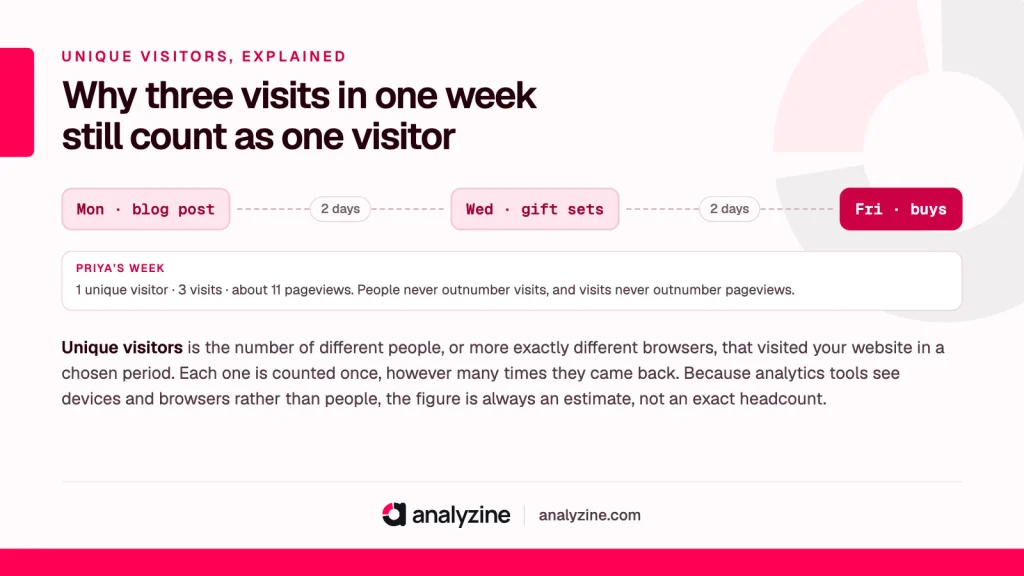
Quick answer
Unique visitors is the number of different people, or more exactly different browsers, that visited your website in a chosen period. Each one is counted once, however many times they came back. Because analytics tools see devices and browsers rather than people, the figure is always an estimate, not an exact headcount.
What counts as a unique visitor
A unique visitor is one person counted once in a given period, whether they came once or ten times. Say Priya reads a post on your candle shop’s blog on Monday, comes back on Wednesday to look at gift sets and buys on Friday. For that week she’s one unique visitor, with three visits and however many pages she looked at along the way.
The period matters more than people expect. Daily, weekly and monthly visitor figures are three separate counts, and the daily figures don’t add up to the monthly one. If you see 200 different people every day for 30 days, your monthly figure is not 6,000. It might be 2,500 if lots of people come back, or close to 6,000 if hardly anyone does. That gap is useful in itself: it tells you how much of your audience is loyal and how much is passing through.
So the number answers one specific question: how many separate people did my site reach? It says nothing about how busy each of them kept you.
How tools count unique visitors
An analytics tool never sees a person. It sees a browser on a device asking for pages. To decide whether two visits belong to the same visitor, it needs a way to recognise that browser again. There are three common approaches.
With cookies
The classic method stores a random ID in a small file in the browser, called a cookie, on the first visit. When the browser returns, the tool reads the ID and knows it has seen this visitor before. Within one browser, for as long as the cookie lasts, this works well.
It stops working when the visitor clears their cookies, browses in a private window or switches to another device. Some browsers also limit how long cookies set by scripts can survive, so a regular customer who stays away for a week or two can come back looking brand new.
Without cookies
Cookieless tools store nothing on the visitor’s device. A common approach is to build a short-lived identifier from details that arrive with every request anyway, such as the IP address and the user agent (a line of text naming the browser and operating system), usually combined with a secret value that changes regularly. Same browser, same network, same day: same identifier.
The trade-off is deliberate. Because the identifier changes, often every day, the tool can tell people apart within that window but can’t recognise the same person next month. That’s a privacy choice rather than a flaw, and it’s covered in more detail in cookieless tracking.
With logins
On a membership site or a LearnDash course, logged-in students identify themselves. An account follows a person across phone and laptop, so it’s the most accurate method there is. It only covers people who sign in, though, and linking browsing to a named account needs more care under privacy law.
Why “unique” is always an estimate
Every method gets it wrong, and in both directions.
Overcounting, where one person shows up as several:
- Priya browses on her phone at lunch and her laptop in the evening. Two visitors.
- She clears her cookies, uses a private window, or her cookie expires.
- With cookieless counting, her identifier changes when her IP address does, for instance when her phone drops off home Wi-Fi onto mobile data.
Undercounting, where several people show up as one:
- A family shares one tablet.
- Without cookies, two colleagues on the same office network with the same browser can look identical.
- Visitors who block your tracker or decline consent aren’t counted at all.
On top of that, some bots slip past every filter.
None of this makes the number useless. It means you should read it as a trend rather than a census. If the count rises by a fifth from one month to the next, measured with the same tool and the same settings, something real changed. Whether you had exactly 3,412 people is something nobody can know.
Unique visitors vs visits vs pageviews
These three get mixed up all the time, but each answers a different question.
| Metric | What it counts | Question it answers |
|---|---|---|
| Unique visitors | Different people (estimated) | How many people did we reach? |
| Visits, or sessions | Separate visits | How often did they come? |
| Pageviews | Pages loaded | How much did they look at? |
Priya’s week gives you 1 unique visitor, 3 visits and maybe 11 pageviews. The order almost always holds: people never outnumber visits, and visits never outnumber pageviews. The details of how a visit is defined are in session, and what counts as a page load is in pageview.
One naming trap: some tools label this figure simply “visitors” or “users”, while others use “visitors” to mean visits. Check the tool’s own definition before you compare numbers.
Why two tools never agree
Run two analytics tools side by side and they’ll show different visitor counts. That’s normal. The usual reasons:
- Different ways of recognising people, as above. A cookie tool and a cookieless tool will never match exactly.
- Consent. A cookie-based tool that’s set up properly only counts people who accept your cookie banner.
- Ad blockers stop some trackers and not others.
- Bot filtering varies from tool to tool.
- Time zones decide where a “day” ends.
- Server logs count every request, bots included, so hosting stats usually come out much higher than any analytics tool.
Pick one tool as your reference and judge changes within it.
How to find and use the figure on a WordPress site
The number is most useful next to other numbers.
- Compare reach with results. If visitor numbers climb but orders stay flat, you’re reaching more people but not the right ones. Check which traffic source brought the new arrivals.
- Count conversions per person when buying takes a while. Someone choosing a £300 course often visits several times first. A conversion rate worked out per visitor gives a fairer picture than one per visit.
- Watch the gap between daily and monthly figures. A widening gap usually means fewer people are coming back.
- Be clear about the source. If you quote monthly visitor numbers to a sponsor, say which tool and which method produced the figure.
Counting people and privacy
Telling visitors apart means recognising a browser again, and that’s where privacy law comes in. In the UK and the EU, storing a cookie or reading information from a device for analytics generally needs the visitor’s consent. That’s general information, not legal advice; the overview of privacy laws covers the details by region. Cookieless counting avoids storing anything on the device, which is why many site owners choose it, accepting a less precise count over long periods.
Analyzine counts visitors without cookies by default and offers an optional cookie mode that only starts after the visitor consents. Either way, the data stays in your own WordPress database.
If you’re setting up analytics now, decide first which matters more to you: precise long-term counts of returning people, or not asking visitors for consent. Then pick the method that matches, and stick with it so your trends stay comparable.
Frequently asked questions
What does unique visitors mean on a website?
It’s the number of different people who visited the site during a chosen period, with each person counted once no matter how many times they returned. In practice tools count browsers rather than people, so treat it as a close estimate.
How are unique visitors counted?
Most tools either store a random ID in a cookie or build a short-lived identifier from details such as the IP address and browser, without storing anything. Logged-in sites can also count by account. Each method over- or undercounts in different situations.
What is the difference between visits and visitors?
It depends on the tool. Some use “visitors” to mean different people, while others use it to mean visits, where one person can be counted several times. Check the definition in your tool’s help pages before you compare figures.
Can you count unique visitors without cookies?
Yes, within limits. Cookieless tools can recognise the same browser over a short window, often a day, without storing anything on the device. They can’t reliably follow someone over weeks, which is the price of not using cookies.
Is the visitor count an important metric?
It’s a good measure of reach, but on its own it says nothing about whether those people bought, booked or signed up. Read it alongside conversions and revenue, and watch the trend rather than the exact figure.
